
Where the Wind Plays
Design and realisation of the dune collection
This project explores the creative force of wind, and the sculptural games I watched it play, growing up along the blustery beaches of Northern Ireland’s Causeway Coast.
Like the sinuous sands it seeks to shape, this journey unfolded through many twists and turns, evolving over three years of conception and refinement.
The resulting Dune Collection emerges as a tribute to the timeless textures of our natural landscape and the dynamic forces that continually shape it.

Awakening
A game begins beneath my feet
Having grown up along the Causeway Coast, I’ve long admired its sweeping shorelines and blustery beaches.
As a child, these beaches were a playground. When cousins visited from England, our parents would bring us here to run wild across the dunes of Whitepark Bay, our laughter lost to the wind.
As an adult, and now a designer, these same sea-soaked shores invite a calmer kind of play: one of observation, reflection, and imagination. I trace the terrain underfoot, where wind and tide sculpt the sand into shifting patterns of calm and conflict.
In one moment, its surface lies smooth and serene; in the next, it ripples into resistance.
The ground almost feels alive, as though the beach is in dialogue with itself, caught between harmony and tension, stillness and movement.
Somewhere in that conflict, I begin to see a game unfolding.
A game of balance, territory, and form.
A game shaped in sand.

Cataloguing the sands
of the Causeway Coast
Over the course of 2024 I visited several beaches along the Causeway Coast in the hope of documenting the various ways in which both wind and tide sculpt the local sands.
Countless forms of relief are catalogued, each reflecting the dynamic and unpredictable nature of this material and the forces that shape it.
Sinuous Ripples
Shallow Scores
Shallow Scores
Grainy Stucco
Wavy Dapples
Ruptured Contours


Hand-drawing allowed me to make sense of the forms beach sand takes. Stripping textures back to abstract diagrams revealed the underlying patterns and systems.
I became interested in how density, intricacy and linearity shifted across a surface, sometimes easing from one state to the next, other times breaking sharply.


Emergence
Recreating the sands of the Causeway Coast
Various relief textures were created using digital scripting to capture the irregularities and intricacies of windswept sand. The articulation of these surfaces could be modified by altering parameters related to relief pattern type, depth, density, direction and degree of randomness.
A fine balance between order and chaos had to be found to ensure the surface relief demonstrated a clear design intent whilst maintaining a degree of natural unpredictability.
Scour
Wavy
Wrinkle
Dapple
Streak
Ripple


Reinterpreting Celtic symbolism
As a symbol of natural growth, spiritual progression, and continuous transformation, the Celtic triskelion motif provided a fitting foundation for the windswept Dune Collection.
The motif was adapted through a process of enclosure, offset and variation, creating a framework for future design experimentation.

Continuous Transformation
Three arms in perpetual rotation with none first or last. The motif holds no fixed state, only an endless becoming, the same condition wind imposes on sand.
Natural Growth
The triskelion’s three arms unfurl from a single origin, tracing the spiral that governs shells, ferns and wind vortices alike. The form emerges through accumulation rather than intent.
Spiritual Progression
Each spiral turns outward without returning, marking a path that advances rather than repeats. Movement is always forward, through cycles that carry us somewhere beyond where we began.

Enclose Motif

Offset Outline

Disturb Paths


Windswept Figures
A range of sculpting techniques were tested to explore how a vessel’s texture and silhouette could work together to achieve the desired windswept effect.
These resulted in a range of surface effects from rippled with deep horizontal ridges, to gently meandering waves. Silhouettes were deformed in different ways to understand how the design would respond under expansion and contraction.

Shaping sand into form
A mixture of hand-drawing and digital sculpting was adopted to help settle the design of the Dune Collection.
It became apparent that the form of each piece should naturally follow on from the last, and appear as though they are being whipped upward by the wind.


Crystallization
Smooth versus rippled, a game of two textures

A chess set is the most rational object in the home. Composed of thirty-two pieces on an eight-by-eight grid, it is a closed system of pure logic.
The Dune Chess Set dissolves that rigidity without altering a single rule. By designing a set that is differentiated by texture rather than colour, black and white are replaced by a monochromatic interplay of light and shadow. The game becomes fractionally slower to read, therefore drawing the hand in to do the work the eye used to do alone, expanding its mode of experience from primarily visual to tactile.


Alternating between chaos and calm, rival pieces advance from opposing peaks before descending into the battlefield below. Each piece is a fluid, windswept volume shaped by pressure and erosion.
Three crests, emerging from turbulence


As the vase tapers at the waist, the rippled surface thins into fine openings, allowing glimpses of its contents.
As its undulating base grows upward, the rippled surface calms, giving way to three sinuously linked vessels for housing tea lights. The granular surface warms under candlelight, catching the flame across every ridge.

Hollowed by circling winds
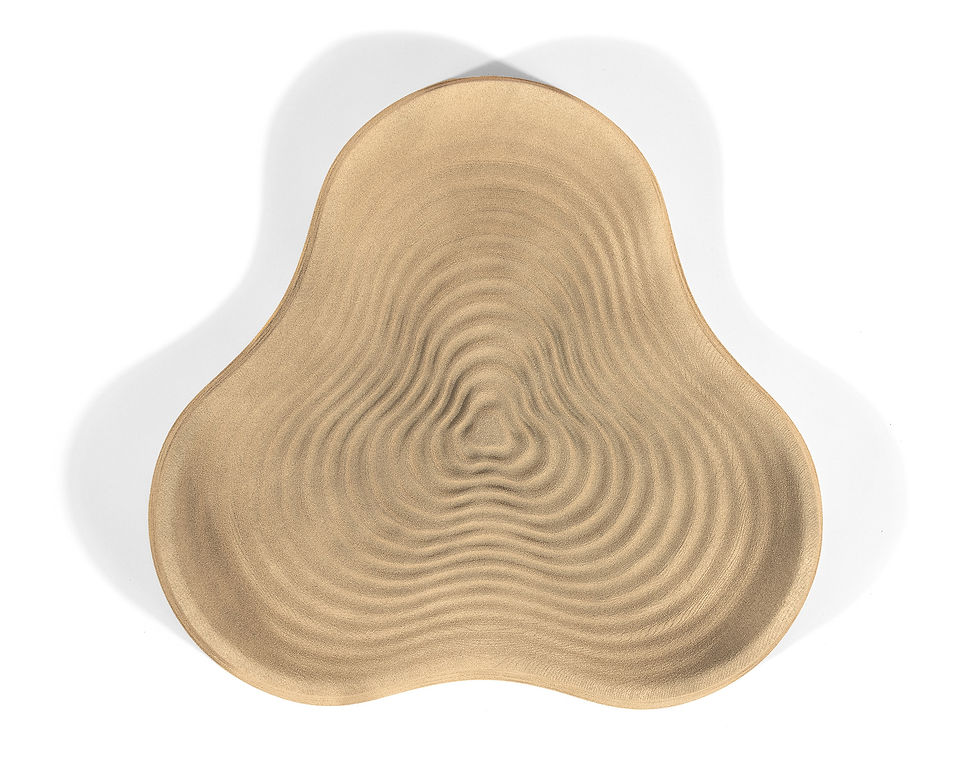


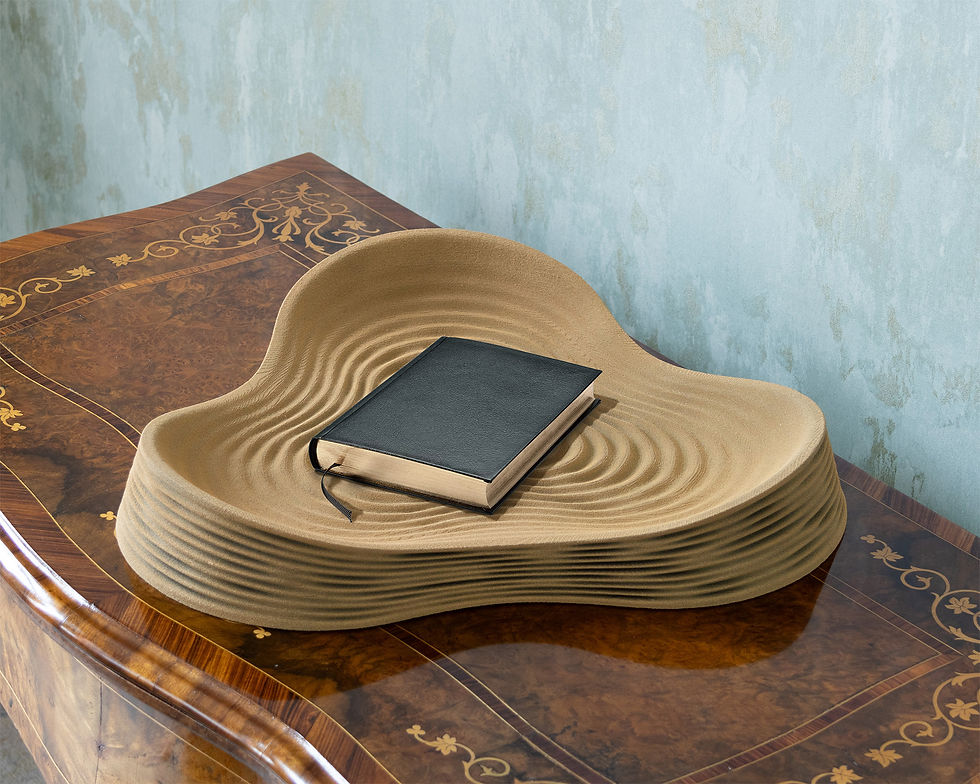
Delicate ripples radiate outward from the centre, forming a sinuous landscape for smaller objects. Low light catches across every ridge, shifting as the day moves around it.
Ripples flow inward and thin until light passes between them, casting a shifting, dappled pattern on the surface below. The grain reads as stepped landscape from above, and as raw material up close. Ideal as a striking dining table centrepiece.
Where the ripples part, light escapes


A solid rippled base rises before splitting to release thin streaks of light that settle into a warm ambient wash.
The Dune Collection

Each piece captures a unique moment of material transformation as sand is whipped upward into solid form.
Sweeping silhouettes and sinuous surfaces are shared across the collection, whilst a tripartite footprint forms the foundation of the vessels and lighting, all descendants of the Dune Chess Set that sparked the project.